


Talk About 1980s Levi’s Jeans - made in USA (501 & Others)
- JungYeol Kim
- Apr 12, 2024
- 4 min read


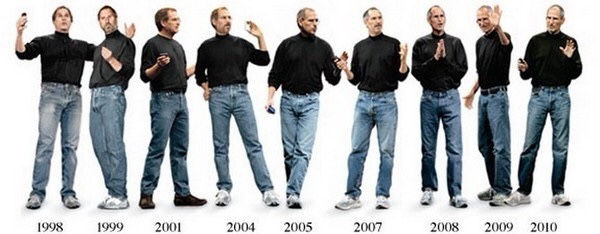
When vintage Levi's jeans are discussed in shops introducing American denim, it's hard not to mention the image of the "Moosgaard Twins." These two, regardless of what they wear, always exude coolness. Even as a guy, seeing their duo shot makes me want to buy vintage Levi's.
0. So I bought quite a lot of them. From the highly sought-after "Original" models to replicas like LVC (Levi’s Vintage Clothing), Warehouse, Full Count, Orslow, Samurai Jeans, and The Real McCoy’s, I've experienced a fair share. Among them, Warehouse stood out in terms of quality, but my tight budget hindered me from shelling out 300,000 won for a pair of jeans.


Warehouse is among the top-tier denim replica brands. Not only do they craft excellent denim, but they also excel in high-quality washing techniques. They're known for producing washes that closely resemble originals, to the point where you might mistake them for the real deal.
I mean, jeans are just jeans, right? They don't need to be that well-made.
To me, jeans didn't need to be the highest quality with premium materials and craftsmanship. I just needed something durable, versatile, and timeless that would fit well regardless of changing tastes. The Levi's jeans produced around the 1980s fulfilled these somewhat picky criteria perfectly. Technically, they were produced from the mid to late 1970s until 1992, but let's just call it the '80s for simplicity. (Does that sound too obsessive already?)

The world of vintage Levi's is vast and deep. Even covering just the Levi's produced from the mid to late 1970s until 1992 would be challenging for one blog post. Fortunately (?), I don't know too many facts or favorite points among them.
There's a concept in vintage Levi's called "Big E." Levi's used to be written in all caps until the early 1970s, hence the Big E represents the older Levi's models. From the mid-1970s onwards, it changed to "Levi's." Even today, except for replicas, you can find the "Small e" red tab on most Levi's models.


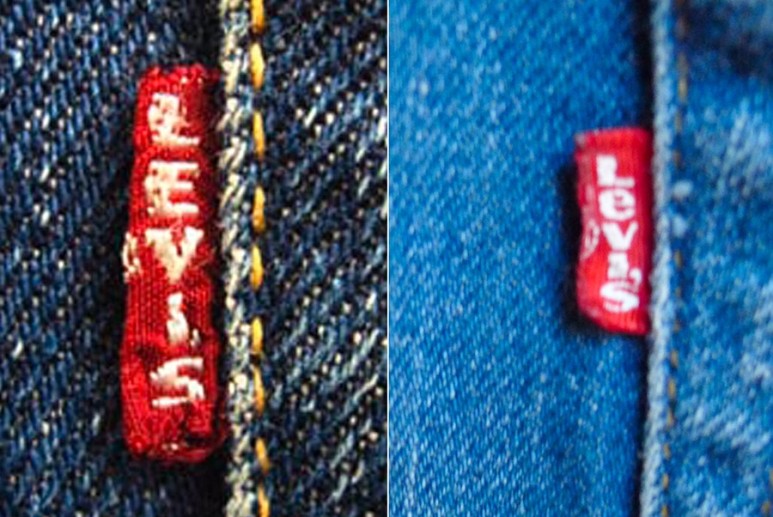
There's a concept in vintage Levi's called "Big E." Levi's used to be written in all caps until the early 1970s, hence the Big E represents the older Levi's models. From the mid-1970s onwards, it changed to "Levi's." Even today, except for replicas, you can find the "Small e" red tab on most Levi's models.

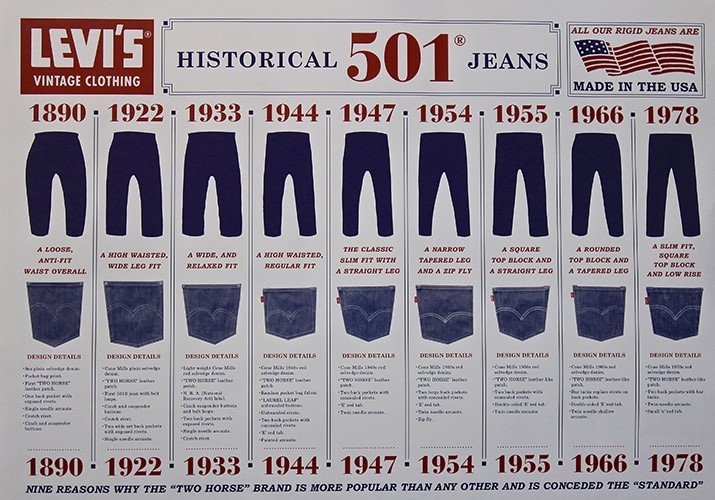
The iconic Levi's model, '501', used selvage denim until 1983. After the switch to the Small e, selvage denim jeans were produced for about ten more years. Compared to the Big E selvage denim produced from the 1870s to the early 1970s (about 100 years), this was a significantly shorter period. Perhaps that's why even the Small e ones receive the same reverence as originals.

LVC (Levi’s Vintage Clothing) also reproduces the selvage denim from that era as '78501 (1978 reproduction)' and '83501 (1983 reproduction)'. In Japan, Levi's 501 from 1966 (66501), with similar fits, patches, and fabric, is called "66 Pre/Post" models. Vintage Levi's, like the Big E, also command high prices.

Later on, through an era where sewing and selvage coexisted, selvage denim fabric disappeared into history. But my favorite remains those from that time.
Even though they're non-selvage, the denim from the 1980s has a texture and weight similar to selvage denim, making it suitable for wearing in all four seasons. The subtle fading of the indigo denim blends well with any outfit, adding a unique charm.






Even though they're non-selvage, the denim from the 1980s has a texture and weight similar to selvage denim, making it suitable for wearing in all four seasons. The subtle fading of the indigo denim blends well with any outfit, adding a unique charm.
These are my hard-worn 1980s Levi's. I need to find a brighter pair, but it seems impossible. If they're going to fade, it'll take at least another 10 years. But they're already so beautiful as they are...
Good denim goes through cycles of washing and wearing, becoming crisp and then soft. With each wash and wear, they shrink slightly but stretch back to their original size, thanks to their inherent elasticity even without spandex.

3. The small and thin font stamped with '501', size markings, and the blank tab. The blank tab was originally attached for quality control purposes in factories, indicating products counted in multiples of 100 or 1000 during production. If you chose a pair with a blank tab, rest assured, it's authentic!

The denim back then was made of Rigid (Shrink To Fit) fabric. So, it's recommended to shrink them in hot water before wearing. Most vintage Levi's appear to be two inches smaller than the labeled size. If it doesn't have a label indicating shrinkage or if it underwent washing, it's advisable to go two inches up from your usual size. I personally prefer a looser fit, so I went three inches up. In reality, it's about one inch up.

The button fly becomes more comfortable over time—more comfortable to open than to close.


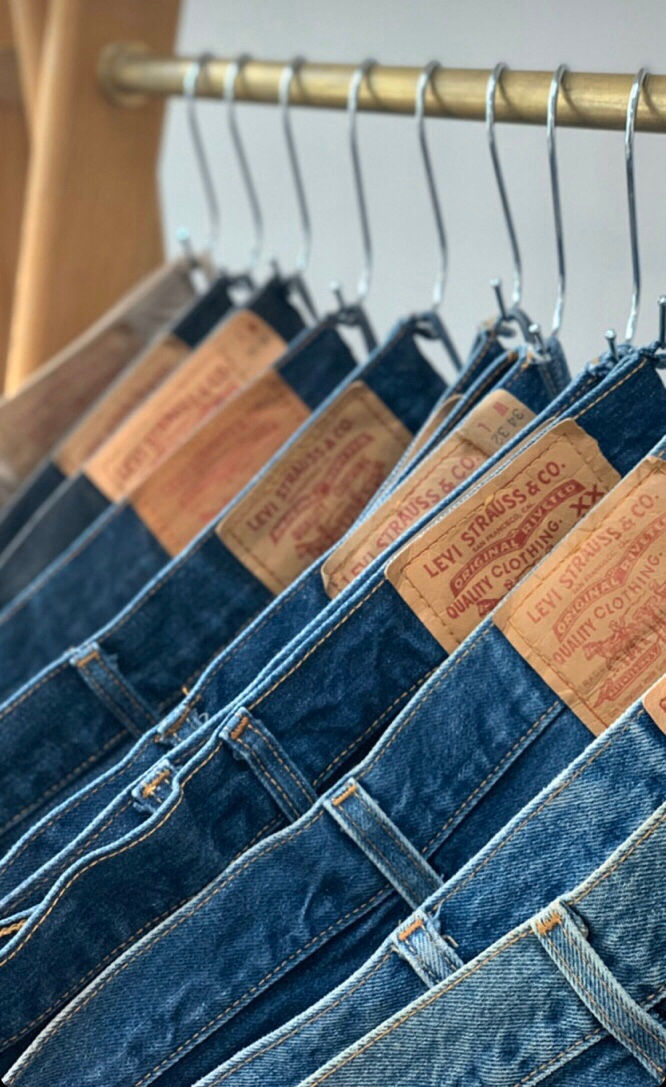
Recently picked vintage Levi's from the 1980s. There were more than I expected. As someone who loves and collects 1980s Levi's, it's not easy to come across such a variety. Having this many could mean they're not popular, or they're so popular that people keep buying them. Maybe both. I want to get a pair in a new blue and another in a beautifully faded blue, preferably both from the 1980s.
<Levis Jeans prices at Soobak, as of 2020>
90s Levi's: 65,000 KRW
80s non-selvage: 95,000 KRW
80s selvage (66 Pre/Post): Around 200,000 KRW


Comments