


Granpa Ralph Lauren's Beloved Item: The Original Navajo Rug
- JungYeol Kim
- Sep 25, 2023
- 3 min read


Do you recognize this very famous photograph? It's the young Doug Bihlmaier at Ralph Lauren's ranch in Colorado. Everywhere you look, it's all vintage, and Navajo rugs.


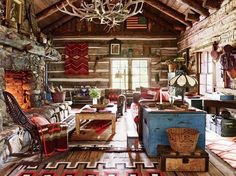
Covering a space entirely with Navajo rugs like this is beautiful, but Soobaak style leans more towards placing just one piece amidst mid-century furnishings in modern space.
It somehow seems to complement traditional Korean Hanok houses quite well, don't you think?
Navajo Rugs: Not Just Rugs, but Art
When we think of rugs, Persian carpets often come to mind. However, the United States is also known for producing excellent rugs, particularly the traditional Navajo rugs woven by Native Americans. These rugs, with their intricate patterns of zigzags, bold reds, creams, black arrows, and fishhooks, have a unique appeal. They catch the eye whether they are hanging on the walls of rustic cabins, bungalows, ranch-style homes, or modern residences. Designers like Ralph Lauren, actors like Kevin Costner and Harrison Ford, and even the owner of the modern furniture chain 'Design Within Reach' have Navajo rugs in their homes. David Roche, an American Indian art expert at the Sotheby's auction house, says that people are interested in Navajo rugs for their decorative qualities, aesthetic value, and emotional connection to the unique and captivating culture and traditions they represent. He describes Navajo rugs as exceptionally compelling textiles with cosmic appeal.
The price of Navajo rugs has seen a 15% increase in sales since the boom of Southwestern-style design in the 1980s. Prices can range from $2,000 to $3,000 for a 4x6-foot rug that takes several months to weave. Antique Navajo rugs from the 19th century have also seen their value rise. For example, a diamond-patterned rug from that era was sold at a Sotheby's auction three years ago for $401,000, which is eight times more than a similar rug sold in the preceding year.
.........
The origin of Navajo rugs can be traced back to the 1500s when Spanish settlers introduced sheep and long-staple wool to the Southwest region. The Navajo people expertly wove these materials into saddle blankets and shoulder wraps, which became popular among other indigenous tribes and Mexican and Anglo-American traders. These large wraps later evolved into rugs.
The dyes used to color these textiles were made by boiling plants and stones. Mixing prickly pear cactus fruits and roots with red rocks created the brownish-red color. Cream-colored wool, light brown, gray, and black backgrounds were achieved by using the wool's natural colors without dyeing. Black wool was obtained by shearing the sheep before the sun had faded their wool.
In the early 1900s, tourists flocked to Indian reservations in Utah, Arizona, and New Mexico, taking Navajo rugs home as souvenirs. To meet the demand, traders started providing Navajo weavers with synthetic dyes and commercially processed yarns, saving time and costs.
However, handwoven rugs made with natural materials and traditional methods are highly prized today. Traditional rugs retain lanolin in the wool, making them soft and heavy in texture. Among them, the most intricate pieces are considered tapestries rather than rugs. Cheap imitations use 6 strands per inch, while high-quality rugs may exceed 30 strands per inch.
Well-made rugs lie flat and even when spread out, with their edges and corners perfectly aligned. However, as they are not machine-made, perfect symmetry is not always achieved, and some weavers intentionally include imperfections. If there is a slight deviation at the edge, it is considered the "soul's mark" – a small stitched symbol of the weaver's spirit and the rug's freedom.
........
[Source: The Hankook Ilbo March 9, 2004 "나바호 러그깔개(rug)는 깔개가 아니라 예술" ]


This is a vintage carpet woven by the Navajo tribe. Our New York branch manager won it at an auction and sent it to us. It seems that Han Nam-dong Soobaak Vintage is focusing more on curating "lifestyle" items, so we've been lacking in carpets and poster frames.
The color combination is in perfect Soobaak style: gray, black, brown, and beige. But upon closer examination, these colors harmonize quite well! This carpet has an ethnic yet modern feel, which is very appealing. Soon, we'll also be bringing in some (not vintage) bests from Mexico.

"YEI: A Supernatural Being Allowing Communication Between the Navajo and the Gods"
"YEI" (YeiBiChai) is a supernatural entity believed to facilitate communication between the Navajo people and the gods. It was believed that by wearing masks resembling deities and performing ceremonial dances, human dancers could summon the spirits of the gods and achieve their purposes. Yei rugs are said to have been inspired by images etched in sand in the early 20th century.

Original post (Korean) : https://blog.naver.com/jy0003/221475720094
Author: Jung Yeol Kim
Written Date: 2019. 2. 27


Comments