top of page


I have a thing for old-school yet sexy pieces like this. This vintage Patek Gondolo? It has that deep charm when worn by a stylish grandma or grandpa. But on someone like Yoo Won, it’s just straight-up sexy.


Recently, I’ve been unexpectedly posting a bunch of watch content on YouTube... but honestly, I’m not one of those people who really digs into watches. I just instinctively know when a watch is beautiful. And I have a rough idea of what a watch means in the broader history of watchmaking. But when it comes to knowing every little detail about the movement or all the technical specs, that's not really my thing.


Of course, my suppliers know everything inside and out. I just don’t feel the need to memorize all that and repeat it to you like a parrot. Soobaak is about experiencing watches through the lens of fashion, not just technical specs.


Now, don’t get me wrong—Soobaak isn’t into watches that scream, “Look at me!” But that doesn’t mean we’re against luxury. We just admire a different kind of luxury, with our own set of standards. And trust me, we love that kind of luxury. Take the AP Bamboo we sold recently, or this white gold Patek Gondolo with original diamond settings I’m showing you today.


That’s what I find so fun about this. How cool is it to casually introduce something like a 'vintage Patek Philippe white gold + original diamond-set Gondolo' at a place like Soobaak, and have someone casually pick it up? That whole vibe is what I live for.

Enjoy, as always, and thanks for the continued support.


🍉 70s VTG Patek Philippe Gondolo

🍉 White Gold + Original Diamond Setting (Not Aftermarket)

🍉 Archive Certificate

🍉 14,000,000 KRW, cash only

  • Suitable for men with slimmer wrists

  • Effortless Elegance: The Vintage Patek Gondolo and the Luxury We Love


  • Kwang min Choi
  • Oct 16, 2024
  • 4 min read


There are a few essential items I consider the foundation of my wardrobe. Well, to be honest, there are probably more than just a few, but if I had to pick, it would come down to 80s-90s Levi’s jeans, a perfectly worn-in vintage sweatshirt from the 80s, and lastly, khaki chino pants.


To understand how khaki trousers became "chinos" and why in Korea, the color khaki conjures up images of army green or olive hues, we need to dive deep into history. (Special thanks to Mr. Bit, the Barber Shop light manager, for his post on khaki history.)


Khaki, a word that originates from the Persian word khak, meaning "dust," refers to the dusty, light-brown color close to beige. In the early 19th century, when the British occupied India, soldiers’ uniforms were made from cotton fabric dyed in this yellow-brown shade to blend with the local terrain. The locals, referring to this dusty color, called it "khaki," and the term stuck.


Nathaniel Eliot Worthington III

After World War II, the uniforms of soldiers returning from the battlefield started to integrate into everyday life. Leftover military surplus was also abundant at the time, which is why we sometimes still come across deadstock pieces today. The quality of military uniforms back then was far too good to be limited to combat wear, and they became staple items, particularly for college students, who found them affordable and practical. Khaki chinos were one of these essential items.


USA Spain War
USA Spain War

Thus, "khaki" became known both as a color and as a term for military-style twill cotton pants. The term "chino" became popular in America during the Spanish-American War. Although the war was centered around control of Cuba, much of the actual fighting took place in the Philippines. After their victory, American troops occupied the Philippines, where locals who spoke Spanish referred to the soldiers' uniforms as "chinos" — a term meaning "Chinese" in Spanish. The reason for this? Many of the tailors who made the uniforms were Chinese, and the fabric itself was imported from China. When American soldiers returned home, they naturally continued using the word "chino."


In Korea, the association of "khaki" with olive-green military colors happened because the term entered the language not as a color, but as a reference to military trousers. At that time, the uniforms worn by the Korean military were olive green, and so the public came to think of khaki (military pants) as being olive in color. Interestingly, the term "national defense color" (국방색) is unique to Korea — you won’t find such a term elsewhere. Perhaps in English, it would translate to something like “National Defense Color.”


Ivy League students wearing chino

For Ivy League students, chinos were available at affordable prices, and you can just imagine a student trying on a jacket at a campus shop, wearing well-worn shoes with chinos.

In summary, "khaki" can refer to either a color or military trousers, while "chino" refers to cotton trousers in general. When you hear "khaki trousers" or "khaki chino pants," most people would probably ask, "Why are they called khaki?" But let’s just agree to call them that among ourselves, shall we?


Chinos generally come in two main styles: Pleated Pants with front pleats and Flat Front Pants with no pleats. U.S. military khaki trousers are typically the flat front type, while French military chinos often feature two forward pleats. Pleats are usually thought of as a European detail, not something inherently American, and this is reflected in the differences between the military uniforms.


1960s French Army Chino

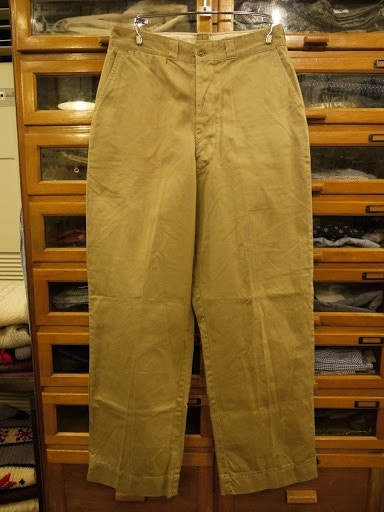
U.S. Army Khaki Trouser(Officer Chino) reproduction by The Real Mccoy’s


Ambrosi Napoli
Ambrosi Napoli


Of course, the ultimate trousers are those handmade by artisans like Ambrosi Napoli or Bernard Zins. There’s nothing more delicate than a well-crafted pair of pants when it comes to menswear. However, within the world of chinos, one cannot overlook the "Polo Chino" by Polo Ralph Lauren. As seen in their 90s advertisements, the belted waist creates a fuller look around the pleats. While not as finely made as a pair of Ambrosi or Bernard Zins, Polo Chinos offer something they can’t — a laid-back coolness that remains stylish even when a little dirt or knee creases start to show. Whether paired with worn-out sneakers or dress shoes, they fit just about any occasion.Khaki Chino Pants: Polo Chino & Officer Chino


The Polo Chino 1991
The Polo Chino 1991


At the time, Polo Ralph Lauren was known for creating traditional, classic items but presenting them in a non-traditional way. Woody Allen comes to mind, doesn’t he? Fun fact: Ralph Lauren himself was responsible for the styling in Annie Hall, so that says it all.

Personally, I love wearing Polo Chinos. I typically size up by 1-2 inches in the waist for comfort. The original purpose of pleats is functionality — they allow extra room when sitting and prevent the trousers from changing shape when you put your hands in your pockets. This is why pleated chinos maintain a smooth silhouette, even when your hands or items are in your pockets. For those who live an active lifestyle or spend a lot of time sitting and standing, I highly recommend pleated chinos.


The Officer Chino, on the other hand, has no pleats but offers a generous rise and wide legs, providing comfort while still working well in dress-down situations. If pleats aren’t your thing, you can’t go wrong with Officer Chinos.

Chinos are considered a basic wardrobe staple, and they’re an easy go-to for everyday wear. I’ve gone a whole week alternating between Polo Chinos and Officer Chinos. They’re perfect for daily wear, especially when you occasionally give them a crisp, ironed crease.


Hello! Welcome to Soobaak Vintage, the vintage shop in Korea known for selling the most Rolex watches. Our main focus has been on vintage Explorer 1 models from around the early 2000s, with a few Submariner 14060s in the mix.


  1. I’ve always preferred getting that one perfect piece rather than collecting many, especially when working with a limited budget. And if you're like me, the vintage Rolex Submariner 5513 might just be the perfect choice.


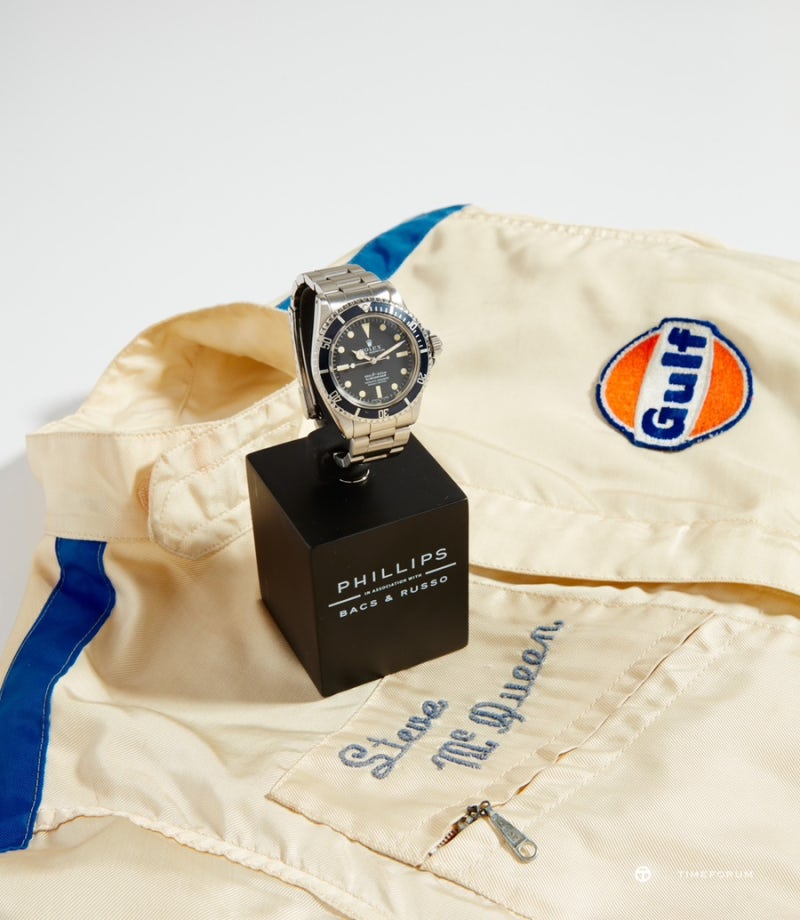
Roger Moore’s Submariner, Sean Connery’s Submariner, Paul Newman’s Submariner, and above all… the king of cool, Steve McQueen’s Submariner!


If you Google Steve McQueen with the 5513, you’ll easily find him wearing it. The photo of him in a simple navy t-shirt, sipping coffee during the filming of Papillon is so effortlessly cool that I believe every vintage Rolex shop should frame it.


  1. Every vintage watch has its own unique charm. While enjoying a vintage piece often involves some level of maintenance, I usually recommend more reliable ones for beginners. The 5513 is definitely one of the best vintage Rolex watches to wear daily, making it into my top 3 vintage Rolex picks.


  1. It’s hard to find another 5513 in this condition and at this price. You could always pay more, of course. One unique feature of this piece is its ‘blank warranty card’. Back in the day, Rolex watches weren’t just sold at luxury boutiques. Our fathers used to buy them at local watch shops, and the blank warranty card was hand-filled by the shop owners.


  1. Now, let’s get into the details of this specific watch: a 1972 Rolex Submariner ref. 5513.


The 5513 was produced from 1962 to 1989, but I have a particular preference for the Mk2 model from the late 60s to mid-70s. It features a matte dial and luminous markers made from tritium, which was the standard at the time.


What’s special about tritium? Over time, the luminous material turns a beautiful yellow patina. And the aluminum bezel, which fades with age, only adds to the watch's charm —and value.


From its domed acrylic crystal to the thin lugs and 40mm case, this watch carries a distinct vintage charm that sets it apart from modern models.


The dial, hands, and luminous markers are all original, with no replacements. It’s likely only been polished once or twice, and it had a full overhaul at a trusted service center last year.


🍉 1972 Rolex Submariner 5513

🍉 With original blank warranty card

🍉 22 million KRW (FYI, the previous owner bought it for 26 million KRW at the most famous vintage Rolex shop in Korea) – cash only.


For those who want to both start and finish their vintage Rolex journey with a single piece, I highly recommend this one. Enjoy it, and thank you as always!


bottom of page